



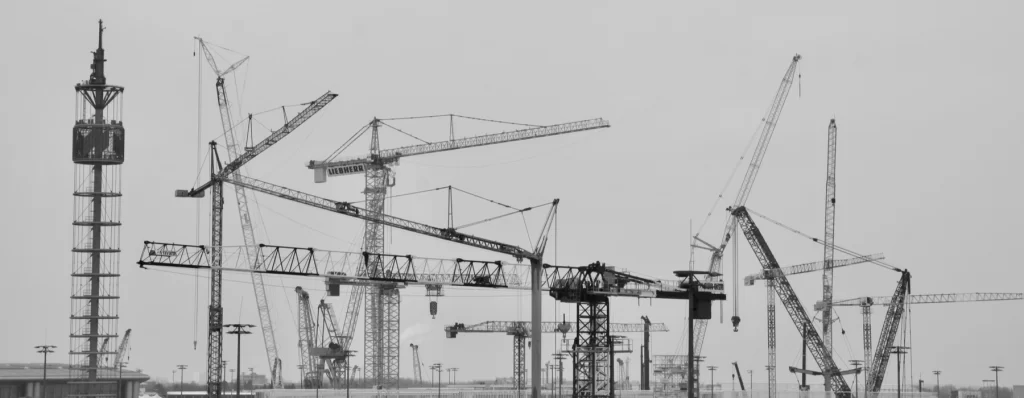
Choosing the right industrial crane depends on your project requirements, workspace constraints, and load capacities. Understanding the operational differences between gantry, monorail, truck-mounted, fixed, and overhead bridge cranes ensures maximum productivity, safety, and cost-effectiveness.
When you work directly with a crane provider to select an appropriate design for your project, you will be able to obtain a flexible crane to make your business more productive and profitable. Consider all requirements—including load weight, operational range, and facility layout—to choose the most cost-effective crane for your job.
Quick Reference: Types of Cranes & Their Applications
| Crane Type | Structure & Mechanical Design | Primary Industrial Application |
| Gantry Crane | Supported by a sturdy steel A-frame on the floor, often with wheels, tracks, or V-groove casters. | Handling heavy loads in factories, lowering, raising, and passing goods horizontally. |
| Monorail Crane | Operates on a single rail with two axes of movement (up and down). Highly maneuverable around curves. | Transporting specific materials along factory assembly lines and warehouses. |
| Truck-Mounted Crane | Features a boom (arm) mounted onto a truck carrier, stabilized by counterweights and outriggers. | Bridge construction, building inspection, and heavy maintenance requiring mobile transport. |
| Fixed Cranes | Station-based units brought to a job site for permanent or semi-permanent assembly. | Long-term construction and heavy-duty localized lifting operations. |
| Overhead Travel Bridge Crane | Runs on elevated runways across buildings with one or two girders. Hooks move in three axes for precise placement. | Moving large loads over long distances across manufacturing and warehouse facilities. |
Detailed Breakdown of Crane Types
1. Gantry Crane
A gantry crane offers many benefits, supported by a sturdy steel A-frame on the floor. With wheels or tracks on their legs, most gantry legs can be moved in and out of buildings. Gantry cranes generally cost less than overhead bridge cranes. Furthermore, specialized options like davit cranes handle loads under 500 kg with a 360-degree turning radius. They help factory owners conveniently lower, raise, and transport heavy goods horizontally.
2. Monorail Crane
Monorail cranes are typically used for lifting specific objects in factories or warehouses. Because a monorail railing moves only up and down (with two axes of movement), it is ideally suited for transporting materials on assembly lines. They are much more maneuverable than bridge cranes, allowing them to travel smoothly around curves.
3. Truck-Mounted Crane
Truck-mounted cranes connect a boom (arm) to a specialized truck carrier, allowing them to travel without complex setup equipment. Counterweights and outriggers provide exceptional stability, enabling them to carry large loads at slow speeds for bridge construction, inspections, and maintenance work.
4. Fixed Cranes
Fixed cranes are based in one permanent or semi-permanent location and are brought to job sites for specialized assembly. While mobile cranes handle broader transport, fixed units anchor high-capacity lifting operations.
5. Overhead Travel Bridge Crane
Utilizing elevated runways, bridge cranes travel over long distances across buildings. Built with one or two girders, their hooks move across three axes, allowing operators to place and position loads with extreme gentleness and precision.
Get Professional Engineering Support with TSCA
Whether you are designing a material handling system, installing industrial monorails, or sourcing electromechanical equipment, partnering with experienced engineers guarantees operational safety and efficiency.
Contact TSCA Electrical Group today for expert assistance with your industrial equipment and material handling requirements, or explore our complete catalog of industrial electrical products and services.