




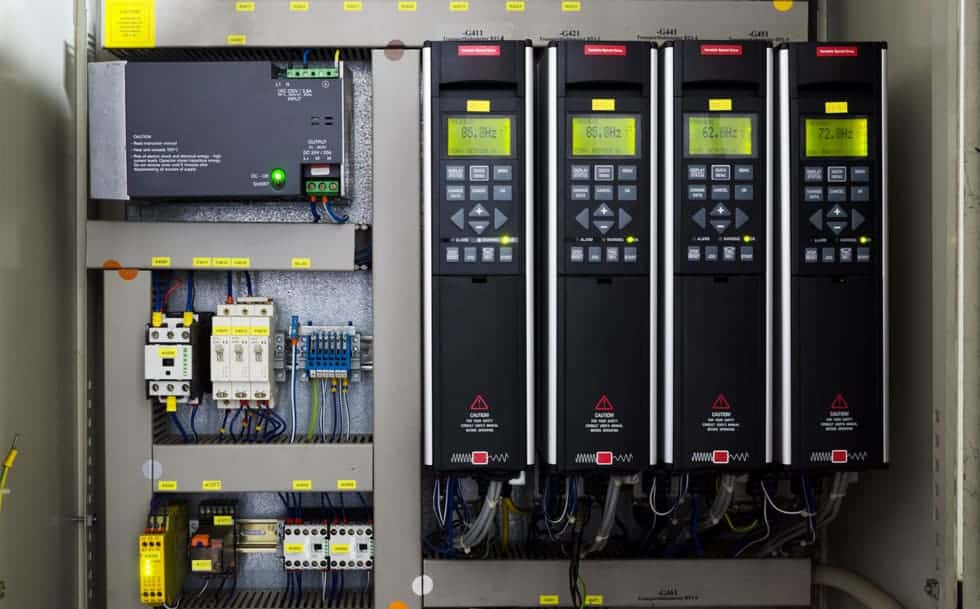
Variable Frequency Drives (VFDs)—also known as Adjustable Speed Drives—regulate the speed and torque characteristics of AC motors by altering waveforms using pulse width modulation. While reliable, they can experience malfunctions that require electricians to evaluate power quality, DC bus voltage, rectifiers, and inverter components.
Variable Frequency Driven Theory (VFD), also referred to as Adjustable Speed Drives, is prominent in today’s workplace. They are used in elevator, water pump, high-volume air compressor applications, and material-handling systems wherever speed and torque characteristics of AC motors are regulated.
In Thomas Edison’s time, the DC motor was used to produce rotary motion from electrical energy to power equipment on farms, homes, and factory floors. The advantage of a DC motor was that motor speed could be easily and smoothly regulated by adjusting the voltage. The brushless AC induction motor, invented by Nikola Tesla and introduced by George Westinghouse, was economical to produce and operate, but its speed could not be efficiently regulated without overloading it and causing temperature rises.
In the 1960s, VFDs were developed to solve this problem by controlling motor speed using pulse width modulation, altering waveforms rather than adjusting voltage to slow down or speed up off-the-shelf induction motors.
Anatomy and Operation of a VFD
A VFD generally refers to the controller with an operator interface, or to the complete assembly including the motor.
- Input Stage: Sixty-cycle AC power from the utility (typically 480 volts) is fed via a branch circuit with over-current protection to the VFD input, where it is rectified and filtered to create a ripple-free DC current.
- DC Bus: Conveys the current to the inverter section. For a 480-volt VFD, the DC voltage is 1.414 times the RMS AC rating due to the full-wave rectifier, resulting in approximately 678 volts. Electrolytic capacitors can also store potentially lethal charges long after power-down.
- Inverter Section: Converts electrical energy into a square-wave AC whose duty cycle (the ratio of peak voltage to off time expressed as a percentage) determines the motor speed.
Quick Reference: VFD Troubleshooting & Diagnostic Steps
| Component / Section | Potential Issue / Failure Mode | Diagnostic Procedure / Test Method |
| Input / Power Supply | Dropped or intermittent phase, poor power quality | Check input voltage conductors and terminations. |
| DC Bus & Rectifier | Ripple voltage caused by failing filter capacitors | Measure using an isolated hand-held oscilloscope or a multimeter in AC volts mode. Check diodes and capacitors using diode/capacitor check modes. |
| Inverter Section | Component failure in insulated-gate bipolar transistors (IGBTs) | Check IGBTs against one another for equivalent operation using a hand-held oscilloscope. |
| Data Input | Modulation setting errors | Consult manufacturers’ documentation and free internet downloads. |
National Electrical Code (NEC) Requirements
VFDs and adjustable-speed drive systems must conform to NEC requirements, specifically covered by Part X in Article 430. Electricians should survey the following points:
- Motor branch circuit conductors: Sized in accordance with 430.22.
- Motor Short-circuit and Ground-fault Protection: Article 430.52.
- Disconnecting means and controllers: Sized and located per NEC Section 430.110 and Table 430.251(B).
- Motor controllers: Article 430 Part VII.
- Grounding and bonding: Conforming to Articles 250 and 430, with equipment grounding conductors verified for the VFD, user interface, and motor.
Contact TSCA Electrical Group today for expert assistance with your industrial electrical requirements, or explore our complete catalog of industrial electrical products and services.