




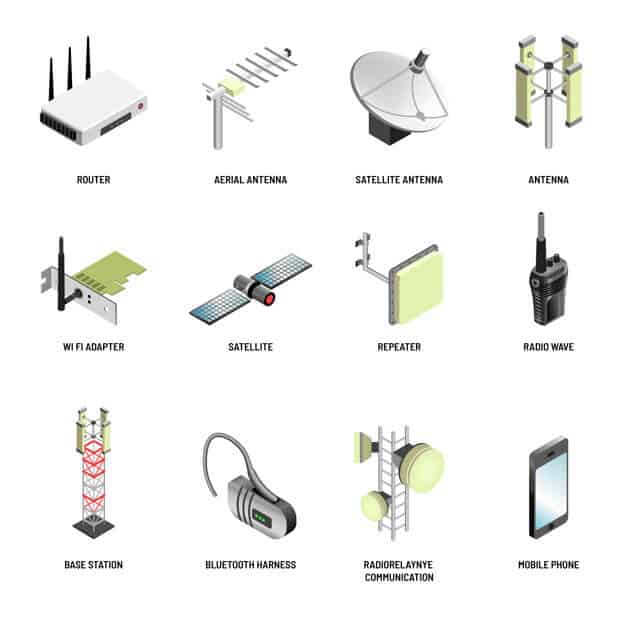
The rollout of 5G New Radio (5GNR) demands a shift from passive devices to advanced active antenna systems. Utilizing Massive MIMO, beamforming, and small cell configurations, these smart antennas ensure ultra-low latency and high-capacity wireless communication essential for industrial and IoT applications.
The introduction of 5G New Radio (5GNR) has transformed wireless communication by offering faster speeds, higher capacity, and ultra-reliable, low-latency connections (under one millisecond) compared to 4G. To unlock the full potential of industrial IoT, smart cities, and mission-critical applications, deploying advanced antenna architectures has become vital for mobile network operators.
1. Active Antennas vs. Passive Systems
Traditionally, antennas operated as passive devices using basic materials like metal rods and capacitors. However, 5G networks require active antennas driven by Multiple Input/Multiple Output (MIMO) and Massive MIMO (utilizing 16×16, 32×32, and 64×64 configurations or higher). MIMO utilizes multiple signal paths at both the transmitter and receiver to compensate for signal attenuation and blockage.
2. Key Technologies: Beamforming and mmWave
Aside from MIMO, 5G relies heavily on specialized technologies:
- Beamforming: Converts radio waves into narrow beams by focusing RF energy directly onto target terminals.
- mmWave (Extremely High Frequency): Operates at higher frequencies to deliver massive bandwidth, though it requires dense configurations of small cell base stations to overcome propagation losses caused by physical obstructions like buildings and vehicles.
3. Real-World Applications
Advanced 5G antennas enable real-time, mission-critical communications across various high-demand sectors, including industrial automation, robotics, connected Vehicle-to-Everything (V2X) systems, and unmanned aerial vehicles (UAVs).
Quick Reference: 5G Antenna Core Technologies
| Technology / Feature | Primary Function | Industrial Advantage |
| Massive MIMO | Multiple signal paths (arrays up to 64×64) | Enhances signal quality and overcomes path blockage |
| Beamforming | Focuses RF energy into narrow directional beams | Maximizes throughput and minimizes interference |
| mmWave Integration | High-frequency short-range data transmission | Delivers multi-gigabit speeds for heavy data loads |
Whether you are scaling commercial infrastructure or upgrading industrial networks, sourcing reliable electronic components is critical to system performance.
Contact TSCA Electrical Group today for assistance, or explore our complete catalog of industrial electrical products and services.